

Getting more from sweet cherry orchards through smarter water and soil management
Introduction
In the Okanagan Valley, maintaining soil moisture is a challenge for cherry production. Drought and limited water availability make it difficult to sustain the consistent soil moisture needed for tree growth and fruit development, while the region’s sandy soils have low water-holding capacity and dry rapidly. Many orchards use micro-sprinkler irrigation systems that distribute water across the soil surface, but water often evaporates off the ground under hot, dry conditions before reaching the root zone.
Drip irrigation may provide a more effective approach by delivering water directly and minimizing evaporative losses. Organic amendments like wood-chip mulch may further enhance soil moisture retention by improving soil structure, increasing water-holding capacity, and reducing surface evaporation. Few studies have examined how irrigation systems and soil amendments interact to influence soil moisture and orchard performance over the long term.
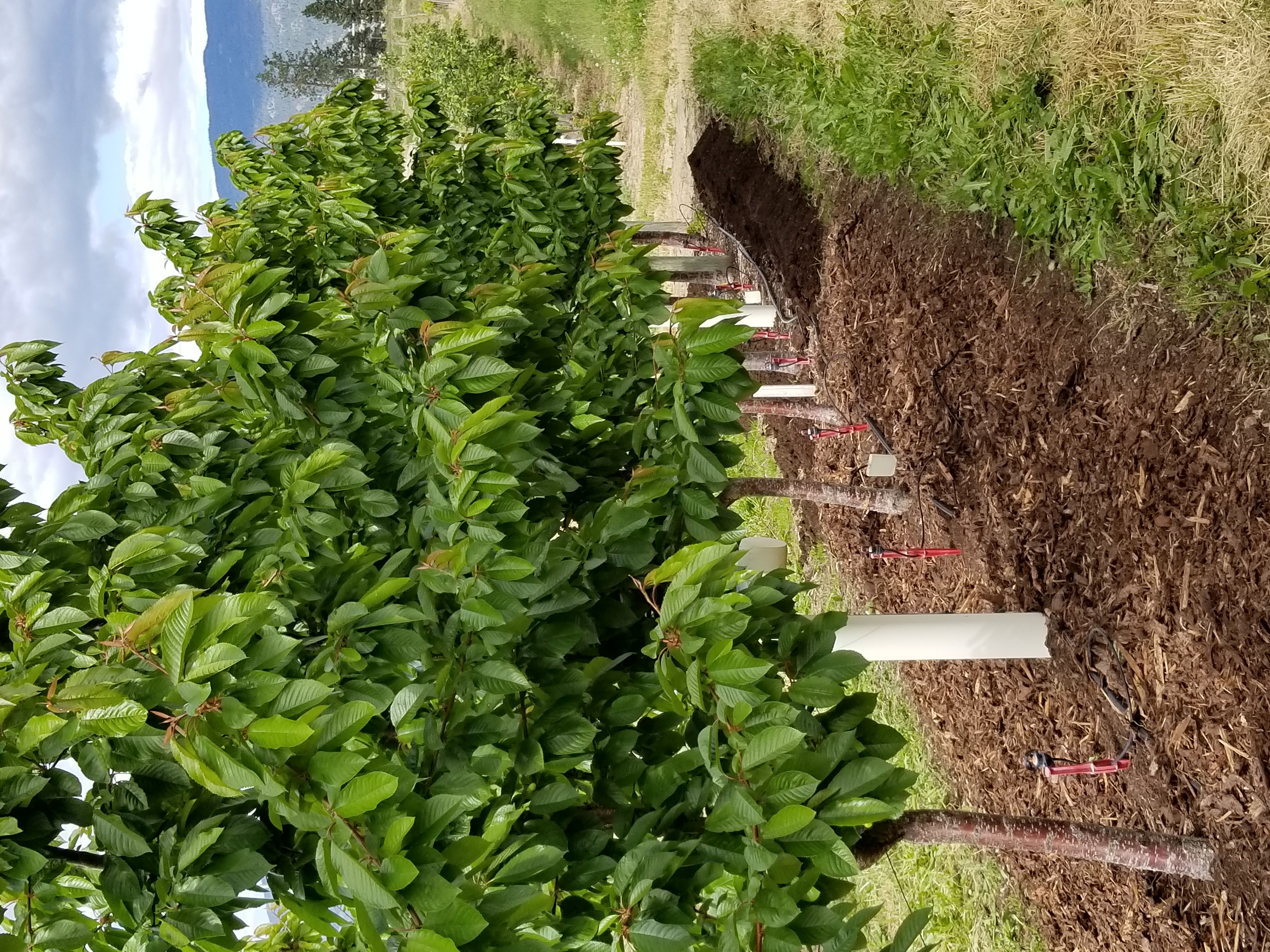
rows. Photo by M. Sharifi, AAFC.
Researchers studied how irrigation systems and soil amendments can help maintain soil moisture. Over seven years, researchers compared two irrigation systems (drip and micro-sprinkler) and five soil treatments (control, fumigation, compost, mulch, and compost plus mulch) to evaluate their effects on soil moisture, tree growth, and yield.
About this brief
This brief was prepared by Nisa Chavez from the BC Food Web team, with the help of Mehdi Sharifi. The brief is based on the following scientific journal article:
- Sharifi, M., Forge, T., Hannam, K., Kuchta, S., Neilsen, D., Asefpour Vakilian, K., & Yasari, E. (2026). Multi-year effects of irrigation method and organic amendments on soil moisture dynamics, tree growth and productivity in sweet cherry under a standardized nutrient input. Scientia Horticulturae, 358, 114715. https://doi.org/10.1016/j.scienta.2026.114715.
Key Findings
Establishing drip irrigation in newly replanted cherry orchards instead of micro-sprinklers helped maintain soil moisture under hot, dry conditions without compromising tree growth, fruit size, or yield. These findings apply to irrigation systems established at planting and do not address the effects of switching irrigation systems in mature orchards.
- Total cherry yields over seven years were the same under drip irrigation and micro‑sprinklers, despite micro-sprinklers using 33% more water.
- Soil moisture was 5% higher and more stable throughout the growing season under drip irrigation.
- Trees under drip irrigation had larger trunks.
- The benefits of the soil amendments tested declined over time. This means that reapplication of soil amendments may be needed to sustain desired benefits.