

Improving evapotranspiration measurements to support better irrigation in BC
Read the research update
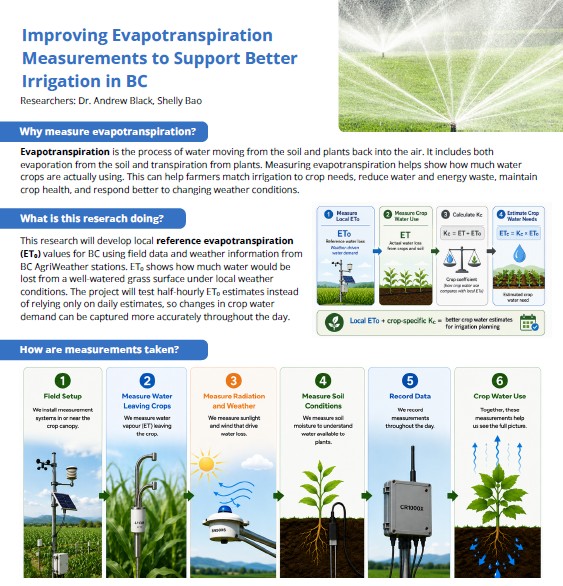
Improving evapotranspiration measurements to support better irrigation in BC
Introduction
As changing weather conditions increase the need for efficient irrigation management in British Columbia, reliable information on crop water use can help farmers make better irrigation decisions. UBC researchers, Dr. Andrew Black and Shelly Bao, are working to develop locally based reference evapotranspiration (ET₀) values for crops in BC using field measurements and weather information from BC AgriWeather stations. These values can help estimate how much water is lost under local weather conditions and, when combined with crop-specific information, help determine crop water needs. The project will also test half-hourly ET₀ estimates to better capture changes in water demand throughout the day, providing more locally relevant information to support irrigation management in British Columbia.
This document provides an introduction to evapotranspiration and its role in irrigation planning. It explains why evapotranspiration is measured, how researchers collect field data, and how locally developed ET₀ information could help BC armers better match irrigation to crop needs. Evapotranspiration-based irrigation is one tool among many, and the factsheet provides a starting point for producers interested in learning how ET information may support irrigation on their farms.
About this research update
To learn more about the project or how evapotranspiration can support irrigation on your farm, contact Dr. Andrew Black at andrew.black@ubc.ca.
This document was prepared by Yussuf Adedeji from the BC Food Web team, with the support of Dr. Andrew Black and Shelly Bao from the University of British Columbia. Funding was provided in part by the governments of Canada and British Columbia through the Sustainable Canadian Agricultural Partnership, a federal-provincial-territorial initiative.
Opinions expressed in this document are those of the author and not necessarily those of the governments of Canada and of British Columbia. The Government of Canada, the B.C. Ministry of Agriculture and Food, and its directors, agents, employees, or contractors will not be liable for any claims, damages, or losses of any kind whatsoever arising out of the use of, or reliance upon, this information.