

Smoke taint in BC: What we know so far
Introduction
As wildfires become more frequent and severe in many wine-growing regions, the potential effects of smoke exposure have become an increasing concern for the grape and wine industry.
Wildfire smoke carries compounds called volatile phenols (VPs), which are released as wood and plant material burn. These compounds can be left on grape clusters by smoke particles and falling ash. When grape berries are exposed to wildfire smoke or falling ash, the compounds can be absorbed through the skins and bind to sugars in the berry. Since these compounds are attached to sugars, grapes can look and taste normal at harvest. Smoke taint often does not become apparent until later in the winemaking process, when yeast breaks down sugar during fermentation and VPs are released. As a result, wine may develop smoky, burnt, or ashy characteristics that consumers find unpleasant. Wines with these characteristics may be harder to sell, resulting in financial losses for growers and wineries and potentially affecting consumer confidence in wines from smoke-affected regions.
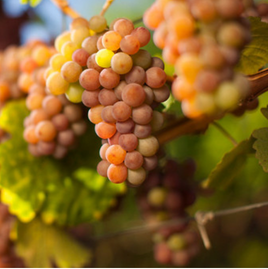
Seeing or smelling smoke in the air does not automatically mean grapes will be tainted. Smoke taint risk depends on several factors, including how long the grapes are exposed, smoke intensity, the stage of berry development, and grape variety. One key factor is distance to wildfire smoke. The closer the wildfire is to a vineyard, the more likely grapes are to be tainted, but vineyards that are further away may still be affected. Another important consideration is how wildfire smoke affects grapevine health. Wildfire smoke can interfere with photosynthesis and other plant processes that support berry development, potentially influencing fruit quality. However, compared with smoke taint, relatively little research has examined these effects. Only general trends in how some factors influence smoke taint have been identified. For example, grapes exposed to smoke shortly before or during veraison tend to produce wines with stronger smoke-taint flavours.
Researchers are still working to better understand smoke taint, how different factors affect its presence and perception, and what strategies can help growers and wineries reduce its impacts.
About this factsheet
This brief was prepared by Nisa Chavez from the BC Food Web team, with the help of Carien Catlett and Wesley Zandberg, and is based on the following scientific journal articles and resources:
- AWRI Helpdesk. Treating Smoke-Affected Juice or Wine with Activated Carbon. Available online: https://www.awri.com.au/wp-content/uploads/2021/02/Treating-smoke-affected-grape-juice-with-activated-carbon.pdf.
- Collins, T. (2024). Nano-scale fermentation Protocol. Washington State University. https://www.washingtonwine.org/wp-content/uploads/2021/08/Nano-Fermentation-Protocol_7.21.pdf.
- Favell, J. W., Fordwour, O. B., Morgan, S. C., Zigg, I., & Zandberg, W. F. (2021). Large-scale reassessment of in-vineyard smoke-taint grapevine protection strategies and the development of predictive off-vine models. Molecules, 26(14), 4311. https://doi.org/10.3390/molecules26144311.
- Jacobson, A., and Hansen, M. (2024). Micro-fermentation (Bucket) Protocol. West coast smoke exposure task force. https://www.wcsetf.org/files/Nano-Scale-Fermentation-Protocol_July-2024.pdf.
- Krstic, M. P., Johnson, D. L., & Herderich, M. J. (2015). Review of smoke taint in wine: Smoke‐derived volatile phenols and their glycosidic metabolites in grapes and vines as biomarkers for smoke exposure and their role in the sensory perception of smoke taint. Australian Journal of Grape and Wine Research, 21(S1), 537-553. https://doi.org/10.1111/ajgw.12183.
- Mirabelli-Montan, Y. A., Marangon, M., Graça, A., Mayr Marangon, C. M., & Wilkinson, K. L. (2021). Techniques for mitigating the effects of smoke taint while maintaining quality in wine production: A review. Molecules, 26(6), 1672. https://doi.org/10.3390/molecules26061672.
- Smoke taint – practical management options for grape growers and winemakers. (2025). Australian Wine Research Institute. https://www.bwga.net/files/AWRI-Smoke-Taint-Practical-Management-Options.pdf.
- Oberholster, A., Wen, Y., Dominguez Suarez, S., Erdmann, J., Cauduro Girardello, R., Rumbaugh, A., Neupane, B., Brenneman, C., Cantu, A., & Heymann, H. (2022). Investigation of different winemaking protocols to mitigate smoke taint character in wine. Molecules, 27(5), 1732. https://doi.org/10.3390/molecules27051732.
Key Findings
- The presence of wildfire smoke does not automatically mean grapes will be smoke-tainted.
- If grapes are smoke-tainted, they may appear unaffected at harvest but develop smoke-like flavours and aromas later during fermentation and wine aging.
- There is currently no single solution for preventing or treating smoke taint. Test fermentations are a key tool for assessing risk and informing harvest and winemaking decisions.
- Smoke taint remains an active area of research, and management currently relies on a combination vineyard and winemaking strategies to reduce its impacts.