

Under cover: What black winter tarps do to farm soils
Introduction
Researchers compared overwinter tarp to cover crops and bare ground to understand how each option affects soil nitrate, moisture, and yield. The goal was to give BC vegetable growers alternatives for protecting soil when cover cropping isn’t possible.
Overwinter cover cropping is common on mixed vegetable farms in BC. Cover cropping prepares the soil for the next growing season by capturing left over nitrogen, improving nutrient cycling, and protecting soil from rainfall. However, it is not always possible to plant cover crops in time. Heavy rainfall can limit equipment access and shorten the already narrow fall planting window. When planting is delayed, the cover crop does not have enough time to develop root systems before cold weather arrives, so it cannot hold soil in place well or take up nitrogen effectively.
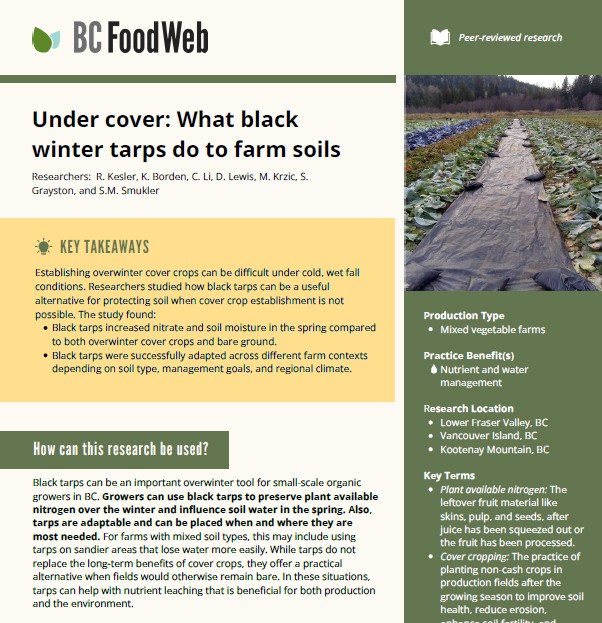
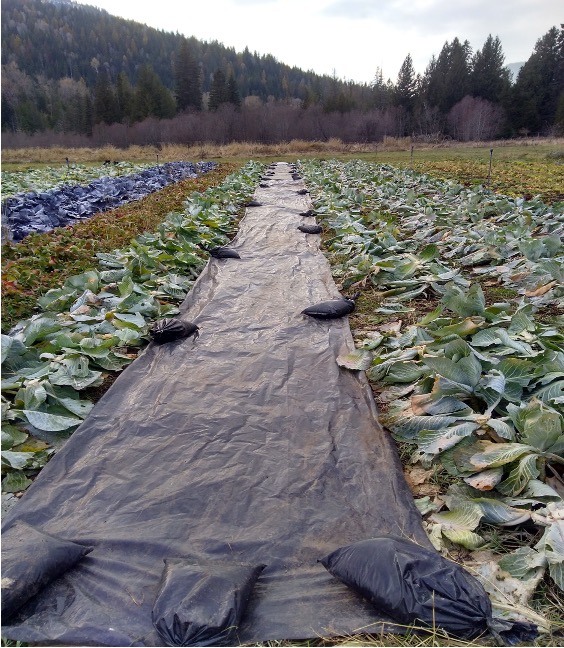
Rather than leaving fields fallow, black plastic tarps were tested to see if they could be used as an alternative. These opaque tarps are thick, impermeable, and UV resistant for up to 10 years. They help keep excess rain out of the soil, which reduces nitrogen losses from runoff.
About this brief
This brief was prepared by Nisa Chavez from the BC Food Web team, with the help of Raelani Kesler, and is based on the following scientific journal article:
- Kesler, R., Borden, K., Li, C., Lewis, D., Krzic, M., Grayston, S., & Smukler, S. M. (2026). Black plastic tarps as overwinter soil cover influence soil nitrogen and soil water content on farms in british columbia. Canadian Journal of Soil Science, 106, 1-14. https://doi.org/10.1139/cjss-2025-0072.
Key Findings
Establishing overwinter cover crops can be difficult under cold, wet fall conditions. Researchers studied how black tarps can be a useful alternative for protecting soil when cover crop establishment is not possible. The study found:
- Black tarps increased nitrate and soil moisture in the spring compared to both overwinter cover crops and bare ground.
- Black tarps were successfully adapted across different farm contexts depending on soil type, management goals, and regional climate.