

Improving the Bottom Line Through Climate-Friendly Nitrogen Application
Introduction
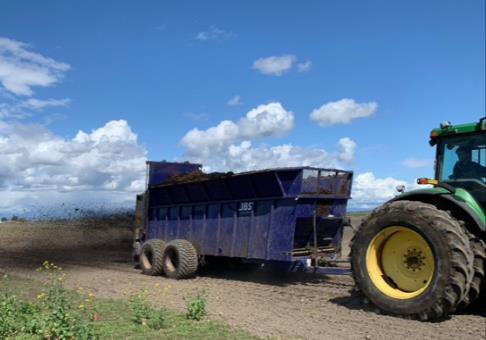
Nitrogen (N) is an essential macronutrient needed for plant growth and development. Nitrogen from fertilizers, composts, animal manures or plant residues provides nutrients that may not be readily available in soil, often increasing yield and farm profitability (Figure 1). Despite over 50 years of agricultural research to improve the use of N, globally, crops typically utilize 50-80% of the N that farmers apply, with the rest lost via microbial consumption, leaching, runoff, or off gassing. It is challenging to synchronize the uptake of N in its plant-available form when and where the crops need it.
The overapplication of N increases financial costs, degrades soil, water, and air quality, and acts as a significant source of agricultural greenhouse gas (GHG) emissions. Improving the efficiency of N fertilizers by utilizing management practices that maximize N uptake by the crop and minimize the loss of N from agricultural lands can benefit the farm’s bottom line while helping the environment.
About this Factsheet
This brief was prepared by Caitie Ciampaglia from the Sustainable Agricultural Landscapes Lab in the Faculty of Land and Food Systems at the University of British Columbia, and is based off the following government sources and scientific journals articles:
- Ali, A., Jabeen, N., Farruhbek, R., Chachar, Z., Laghari, A. A., Chachar, S., Ahmed, N., Ahmed, S., & Yang, Z. (2025). Enhancing nitrogen use efficiency in agriculture by integrating agronomic practices and genetic advances. Frontiers in Plant Science, 16, 1543714. https://doi.org/10.3389/fpls.2025.1543714
- Government of Ontario. (2005). Environmental impacts of nitrogen use in agriculture. Retrieved on June 10, 2025, from
https://www.ontario.ca/page/environmental-impacts-nitrogen-use-agriculture - Govindasamy, P., Muthusamy, S. K., Bagavathiannan, M., Mowrer, J., Jagannadham, P. T. K., Maity, A., Halli, H. M., G. K., S., Vadivel, R., T. K., D., Raj, R., Pooniya, V., Babu, S., Rathore, S. S., L., M., & Tiwari, G. (2023). Nitrogen use efficiency—a key to enhance crop productivity under a changing climate. Frontiers in Plant Science, 14, 1121073. https://doi.org/10.3389/fpls.2023.1121073
Key Findings
On both a global and local scale, farmers are currently overapplying N. This overapplication not only affects a farm’s bottom line but also has impacts on the environment and climate. To address these issues, efforts should concentrate on improving NUE, which will simultaneously increase farm profitability and reduce agricultural GHG emissions.